

The second day of our Rioja wine tour took us to Vinicola Real and Bodegas LAN. Both these could be considered ‘new kids on the block’, in Riojan terms, dating back to just the 20th Century. However, the span of history we covered was incredible as I will describe.

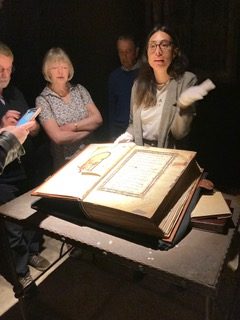
Vinicola Real was founded in 1989 by Miguel Angel Rodriguez, whose family already made vermouth and spirits. He was determined to honour traditional approaches to winemaking that had been practiced in the vineyards of the site he chose for his bodega: the San Martín monastery in Albeda, which had been abandoned in the 12th Century and destroyed by a landslide in the 17th Century. As Jessica our host explained, history permeates the site, despite its hundreds of metres of cellars having been excavated only within the last 30 years. We explored these, including their bottles of Gran Reserva still maturing (under cover of thick mould!), going right back to their first vintage in 1992. At the end of the cellar exploration Jessica showed us a Codex dating from 974-6BC, or rather a facsimilie, the original kept very safely in a museum. This was of one of the documents that the monastery preserved, with beautiful calligraphy and illustrations (and word puzzles), and historic content – including the first record of arabic numbering in Spain.
We then emerged to taste their wines amid the artworks that the winery display. Tim Atkin designated Vinicola Real a ‘First Growth’ among Rioja estates (as was La Rioja Alta yesterday), and their wines were excellent. Our tasting ranged from their ‘basic’ white and red ‘Cueva de Monges’, through their flagship 200 Monges Reservas and Gran Reservas, to Confesor. We finished the tasting with a botrytised Viura, only made in years when conditions permit, and a lovely revelation of what Riojan wines can do!


From Vinicola Real we headed north east, to arrive at Bodegas LAN, another recently founded winery, this time in 1972 by a group of Basque businessmen. Though now owned by Sogrape, the engineering background of the founders shone through in the winery’s design. Led by Marian and Stephanie we descended through an underground salon into the winery, and spent a while marvelling at the totally automated piece of kit which took upright bottles and placed them horizontally into the cages where they are stored.
This was just a trifle by comparison with what we were about to see.
Their barrel cellar was a marvel. The size of an aircraft hanger, with yet more automation, but not a cold, industrial place because it was full of clearly the most delicious wine. Marian explained that LAN (which takes its names from Logroño, Alavesa and Navarra, the regional homes of the Rioja region) only makes wines aged in barrel, so everything they make passes through this place. It could house 50,000 barrels, currently there are 19,000 so there’s room to grow! We learnt that every parcel of wine (from their own vineyards and bought in from growers) is vinified and aged separately, and that they seek out older vines, and increasingly organically farmed vines. Their winemaker, María Barùa, is an expert in oak, and they constantly experiment with different sources of oak and levels of toast.

Back on the surface we enjoyed a tasting of three of their wines: a Verdejo from Rueda (they currently make no white Rioja), their LAN D-12, a very fresh fruity Crianza, and their Xtrème Ecologico Crianza, made from grapes from their Lanciano Vineyard, which is contained within a meander of the Ebro river a few miles away and is divided into 22 plots of different soils and aspects.


Lunch was taken at an enormous long table, and Alberto, their Marketing Manager, led us on the wines – an Albariño from Rías Baíxas, their Viña Lanciano 2016 – a blend of Tempranillo, Graciano and Mazuelo grown in the Lanciano vineyard, which had just won 95 points in Decanter Magazine’s Rioja special report, and both the 2015 and 2016 vintages of their LAN Gran Reserva – showing the contrast between the concentration and density of the 2015 (a top vintage) and the approachability of the ‘lesser’ 2016. We ended, appropriately, with the Culmen 2017 vintage. This showed ably why a wine ‘only’ designated Reserva can be a top wine. Made from grapes from the Pago el Rincón plot, the best part of the Lanciano vineyard, its focus was on fruit and ‘terroir’ complemented by an appropriate amount of oak. It was fabulous.
Our lunch, of fresh asparagus, hake, beef cheeks and a millefeuille (whose chocolate sauce went awfully well with the Culmen), was a pleasure, and we applauded the team who had hosted us and fed us enthusiastically.


We could have stayed far longer at both these wonderful wineries, and at each learnt new things about the region and discovered new aspects to its wines. But there are only so many hours in the day, our kind hosts needed to get on with their day jobs, and and the tapas bars of Logroño awaited us…