

On the coach en route to our first visit near Gimileo Tim gave a short overview of some of the changes happening in Rioja, where many wineries are now pushing at the limits of the DOCa classification, making wines that don’t fit the strict rules regarding time spent in oak and bottle, but are of high quality and bring the grapes and terroir of the region to the fore. Both our visits gave us opportunities to understand this better.

At Santalba, a winery founded in 1998 by Santiago Ijalba, his daughter Laura gave us a thorough, passionate – and very entertaining – tour and exposition of their history, starting in the vineyard just beside the winery, with birdsong in the background. Santiago had worked in the wine business for many years before setting up his business with his wife, whose family owned vineyards. At Gimileo they enjoy a microclimate because of their proximity to the river, and the protection of particular mountains to the north. The former reduces the extremes of temperature that Riojan vineyards can suffer, while the mountains protect from the cold and wet Atlantic winds.
They farm their own vineyards organically, but some of the grapes they buy in are not organic so not all their wines claim this. In the winery, designed by Santiago back in the 90s, and highly innovative at the time, Laura explained that they make a huge variety of wines. They export widely and have many clients, and have responded to changes in the market place: fizz, natural wine, orange wine, lower alcohol wine, Kosher wine, even amarone-style wine! All of these require very specific steps in the winemaking process that add complexity – always at harvest time! There’s a specific tank only used for the Kosher wine, and for that tank they have to observe rules about working on the Sabbath! In the barrel cellar Laura described how they rack their natural, unfiltered wines and showed us the larger barrels (not fitting the requirements of the DOCa for aged wines like Crianza and Reserva) which they use for more fruit driven wines of high quality.
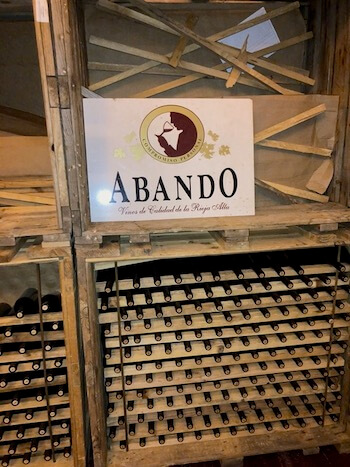
The bottle room was very different to what we are used to. Rather than steel cages, the bottles were in cages made from wood – gentler, less vibration, better for managing temperature and humidity. The cages are made from untreated wood (otherwise they would risk cork taint). It was a wonderful experience, we left the winery with our heads full of thoughts.
In the tasting room, to the accompaniment of carefully chosen tapas, we tasted six wines. Their Brut Nature Method Traditional fizz made from 100% Viura was bright and floral, with a lovely creamy texture – perfect with Iberico ham. Their Abando Blanco was gorgeous, golden in colour, complex flavours and great acidity and lovely with the smoked salmon and cream cheese. Their natural 100% Tempranillo had seen no oak and was very intense, reflecting the low yield of the organic vines and was a great pairing with the spicy chorizo. The OGGA is made from grapes from their family vineyards, it’s a field blend of mainly Tempranillo that has spent 20 months in French oak, none of which important information would be imparted by its ‘Reserva’ classification. The 2017 had beautiful fruit and earthy notes, scented vanilla from the oak, and a wonderful structure. It paired very nicely with the tortilla, but actually could have spent another 20 years in the cellar and been even more spectacular. Our final wines were very much off the scale: at a client’s request they created an Amarone-style wine, drying the Tempranillo grapes for a month after harvest, and using imported yeast from Masi in Valpolicella to ensure the concentrated must fermented to dryness. If we had tasted it blind we would never have guessed it was a Rioja, its 15.5% alcohol was balanced by powerful rich fruit, and the spiciness of French oak. It was lovely with the blue cheese and walnut. The final wine was a sweet wine, made from Malvasia (of which they have a few vines) and Viura. Very light in body but powerful flavours of honey, blossom, tropical fruits, and a perfect end to a perfect tasting.
Everyone was so blown away from this visit, Laura had conveyed so brilliantly the innovation and dedication of the family, and Tim’s tension levels rose slightly as we were already half an hour late and people wanted to buy some wine. We were very sorry to go.


Luckily it wasn’t too far to Cenicero, and Finca Valpiedra, and Tim relaxed when he realised that Letitia, our host, was the sister of one of his contacts at Bodegas LAN, and hospitality and humour clearly run in the family. Letitia introduced herself to us over a glass of their Rueda wine, and then took us to the viewing platform outside the building, directly above the Ebro river. In the vineyard she explained about the Valpiedra site – a series of natural terraces in a meander of the river, with a variety of soil types. The earth where we stood seemed to be mainly stones, but there is also clay and sandy soil, and they have established which varieties do best in which sites, planting the very rare Matuarana on the lowest terraces near the river, and grafting Garnacha onto existing roots when the Cabernet Sauvignon originally planted there did not do well.

Letitia explained that Valpiedra (which means valley of the stones) is part of the Bujanda group, a family business that owns five wineries in Rioja, Rueda and Castilla La Mancha. They are part of the Grand Pagos de España, wineries that are determined to take their wines to the very top level, being part of the group lends an authority to the wines they make that would not qualify for a Reserva or Gran Reserva designation but are of higher quality with more complex winemaking than many that do.
Recent vintages in Rioja have been difficult, with very low rainfall and heatwaves during June to August. It was noticeable that bush vines seem to do better in these conditions than trellised vines, and it made work in the vineyard very challenging, getting the right balance between shading grapes from sunburn and allowing them to ripen.
In the winery there was plenty of stainless steel and oak barrels but also some new things. A concrete tank is used to ferment their Grenache, and they add shoots from the vines to the must, weighed down by stones, to assist in filtering the wine when it is removed. A granite egg is used to age their Gran Reserva wines for a year, and they rack all their wines every four months (six is considered to very good practice!).


We ascended to the tasting room, which of course overlooks the river. Here we tasted through their range of reds, the Cantos de Valpiedra is a very fruit driven Crianza – by which I mean not just fruity but also with quite a lot of tannic structure. The Reserva Finca Valpiedra had even more fruit/tannin and additional oaky notes of coffee and balsamic, and Tim had arrange for us to compare the current 2016 vintage with the 2010 from their ‘library’ of old vintages. This showed how beautifully this wine will age – the 2010 was fabulous, with cedar and violets, farmyardy notes, it feels like I’m describing a mature Bordeaux! But definitely a Rioja! To freshen our palates we then had their Finca Valpiedra Blanco Reserva 2017 which was also fabulous, golden colour, complex flavours, lovely acidity. Duly refreshed we were ready for the Petra de Valpiedra, 100% Grenache (made in the concrete tank above), 20 months in new French oak with low toast, it was a brilliant contrast to the Tempranillo wines, and yet more proof that there is a variety of wines and styles in Rioja that we had not expected.
After all that there was lunch! In their equally spectacular dining room, a traditional Riojan lunch of croquetas, patatas riojanas, roast lamb and cheesecake was accompanied by several of the wines we had tasted before, plus a lighter white and to finish a sweetie. A quiet coach it was on the way back to Logroño.