
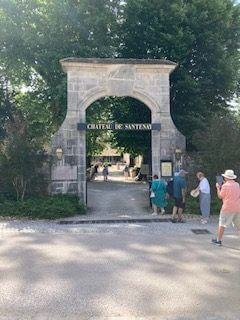
 Our longest drive of the tour, about an hour north up the autoroute, and to the village of Santenay where jumped off the bus which had become somewhat jammed in a tight corner. Leaving Estelle, out very capable driver, to extract it, we walked up the hill to the beautiful Château de Santenay. I experienced acute roof tile envy.
Chloe, our guide, met us on the bridge across what had been the moat of the original ‘camp’, used as a refuge by locals during marauding raids prior to the Middle Ages. It has its own water source so a siege could be withstood for a long time, and the same source also feeds thermal springs which for some quirk of French planning laws means Santenay is allowed to have a Casino.
The current chateau dates from the 14th and 16th century, and its most important owner from a wine perspective was the founder of the Duchy of Burgundy
Philippe le Hardi was the last son of king John II of France. In 1395 he decreed that no Gamay was to be grown in his duchy, the very first rule that would lead to the system of French appellations, and reducing Gamay to this day to a few regional appellations north of Beaujolais.
 The subsequent history was a bit complicated, but of relevance was recognition from Henry IV in 1599, gifting the two plane trees at entrance, one of which had been split by lightning.
Following the French Revolution, in 1796 the chateau was saved from requisitioning because it could be proved to be defensive rather than offensive, and, of course, productive.
Known for many years as Château de Santenay, the winery was recently renamed Ch âteau Philippe le Hardi, and has 98ha of vineyards in Mercurey, Cotes de Beaune and Cotes de Nuits, and a pretty phenomenal reputation for quality.
We descended into the moat to access the cellar, the oldest part of which had been the village gaol. A lot of barrels, of course, but also evidence of experimentation with amphorae made of sandstone and clay being used for both red and white wines to understand the extent to which oak influences wine rather than terroir. The hope is that such vessels used in hot vintages may help keep wines fresher.
 Back up to the tasting room, where we tasted three whites and three reds, each distinctive and representative of its terroir.
The Borgogne Côte d’Or was made from grapes from la Chaise Dieu vineyard near Saint Aubin, and had lovely smoke, toffee, lemon curd and a spicy mouthfeel while being very fresh and more-ish. The Mercurey ‘l’Or des Ducs’, was fresher still, with some minerality and generally more aromatic, while the Chassagne Montrachet seemed rather restrained at first but in the glass opened out to present a fabulous array of flavours – lemon posset, stewed apple, dried lemon spices.. I could go on.
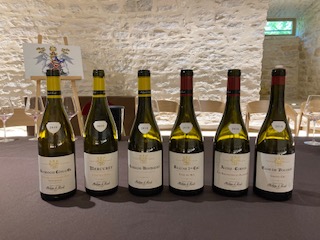 Our reds were a Beaune Premier Cru Clus du Roi, followed by a ‘village wine’ from Aloxe-Corton, and then a Clos de Vougeot Grand Cru. These built in power and complexity, but each was individually lovely, all showing aromas of roses and spices, beautiful red fruits and increasing amounts of vegetal/farmyardy aromas and flavours.
This was an amazing visit and I am very glad that Tim sells their wines at home!

 After a very pleasant lunch in the Terroir restaurant in Santenay (thankfully indoors as it was absolutely boiling outside), we drove to Rully in the Côte Chalonnais.
 Here we visited André Delorme, whose namesake set up to sell sparkling wines in 1943. Our guide was Monique, and she explained that André’s son Jean Francois expanded the business in the 1950s, buying vineyards in other Chalonnais appellations and making still wines too. In 2005 the business was bought by Eric Piffaut, owner of Veuve Ambal.
Monique gave a perfect explanation of the method traditional process for sparkling wine using the original equipment they stopped using in 1960s.
Crémant de Bourgogne is a blend of some or all of Chardonnay, Aligoté, Pinot Noir and Gamay, aged on the lees for at least 9 months before disgorgement (36 months in the case of Prestige classified wine).
In the cellar she described the varied soils of the Côte Chalonnais and we could see layers of limestone that lies beneath the Rully appellation.
There were a lot of barrels, all French of course. Some were emptied ready for cleaning before next years wines are made. All Delorme’s still wines are matured in oak, with the exception of the Bouzeron of which more below.
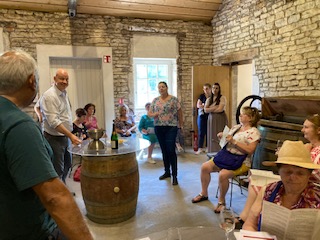 We tasted two Crémants, a ‘basic’ Brut (Terroirs Mineraux) and their Cuvee Anniversaire Blanc de Blanc from 2017. I particularly like the latter which had a lovely lemony yogurt nose, and a perfect dosage.
The Bouzeron appellation can only use the Aligoté grape, and is therefore often passed over. Their 2019 wine proved this is a mistake – a lovely complex nose of white flowers, hedgerow and pear, and a rich texture with a savour finish – very foody.
The Givry white, which had spent 15 months in oak was very delicate but developed lovely lemon cheescake flavours on the palate. The Montagny Premier Cru, which had spent 18 months in oak, was very classy – hazelnuts, spice, apple, lemon coming together very harmoniously.
For reds we tasted a Rully, which was a fairly light wine with pleasant flavours of fruit and hints of spice and rose petals, whereas the Mercurey Premier Cru Clos l’Eveque, grown on more clayey soil, was far more powerful, with dark berry fruit, lovely vegetal flavours and pretty florality.
This tasting just scratched the surface of the Côte Chalonnais and its five appellations, and has whetted appetites to explore further! A great finale to our programme of visits.

Our final night dinner was at the Poisson d’Or restaurant on the River Saone, a couple of km north of Macon. A few brave souls walked – and aided by the strong southerly wind that was developing and slightly mitigating the heat. A super meal, and great exchanges of memories and hopes to see one another again, a taxi home – and apart from breakfast and a free morning in Macon, and the return to Lyon airport, our tour has ended.
